

Construction Products Regulation (CPR)
Regulation (EU) No 305/2011
The Construction Products Regulation (CPR) lays down harmonised rules for the marketing of construction products -including cabling for fixed installations- in the EU. The Regulation provides a common technical language to assess the performance of construction products. It ensures that reliable information is available to professionals, public authorities, and consumers, so they can compare the performance of products from different manufacturers in different countries.
- Full text of the Regulation (EU) No 305/2011
The Construction Products Directive (CPD) 89/106/EEC of 21 December 1988 on the approximation of laws, regulations and administrative provisions of the Member States relating to construction products. (OJ No L 40 of 11 February 1989)
The Construction Products Regulation (CPR) EU – No 305/2011 of the European Parliament and of the Council of 9 March 2011 laying down harmonised conditions for the marketing of construction products and repealing Council Directive 89/106/EEC. (OJ L 88 of 4 April 2011)
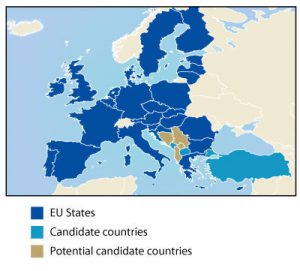
The CPR can also apply in countries outside the EU that have been authorised to implement the regulation.
The CPR lays down conditions for the placing or making available on the market of construction products by establishing harmonised rules on how to express the performance of construction products in relation to their essential characteristics and on the use of CE marking on those products.
| Construction Products Directive (CPD) 89/106/EEC | Construction Products Regulation (CPR) EU 305/2011 |
|---|---|
| 6 Essential Requirements | 7 Basic Requirements for Construction Works |
| 6 Attestation of Conformity systems | 5 systems for Assessment and Verification of Constancy of Performance |
| ETAGs / CUAPs for ETA | European Assessment Document |
| Certificate/Declaration of Conformity | Declaration of Performance (DoP) |
| Clear meaning of CE marking | |
| Simplified Procedures | |
| Requirements on Notified Bodies | |
| Enhanced market surveillance | |
| Product Contact Points in Member States |
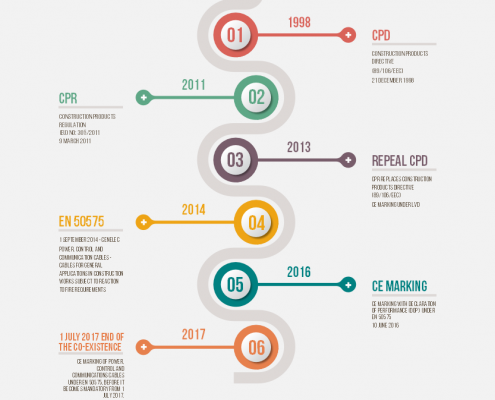
The CPR aims at a simpler, clearer and more effective legislation to ameliorate the Internal Market for construction products.
The CPR prescribes 7 basic requirements for construction works (BWRs):
- Mechanical resistance and stability (BWR1)
- Safety in case of fire (BWR2)
- Hygiene, health and the environment (BWR3)
- Safety and accessibility in use (BWR4)
- Protection against noise (BWR5)
- Energy economy and heat retention (BWR6)
- Sustainable use of natural resources (BWR7)
The construction works must be designed and built in such a way that in the event of an outbreak of fire:
- The load-bearing capacity of the construction can be assumed by for a specific period of time
- The generation and spread of fire and smoke within the construction are limited
- The spread of fire to neighbouring construction works is limited
- Occupants can leave the construction works or be rescued by other means
- The safety of rescue teams is taken into consideration
Uniform assessment methods for performance & rules for factory production control have been compiled in harmonised technical specifications for construction products using common technical language.
Benefits of CPR for stakeholders
- free circulation of construction products in the EU’s Single Market – products have to be tested only once according to a harmonised European standard or European Assessment Document
- national authorities can set performance requirements using the harmonised European standard or European Assessment Document
- users of construction products can better define their performance demands
- market surveillance can rely on one common information structure.
Benefits of the technical tools of the CPR
- the Declaration of Performance(DoP) delivers information on the performance of a product
- the Assessment and Verification of Constancy of Performance (AVCP) is a system defining how products are assessed and how the constancy of the assessment results is controlled
- clearer roles for Notified Bodies(NB) and Technical Assessment Bodies(TAB)
Manufacturers’ responsibilities include (Article 11)
- drawing up declarations of performance(DoP) for their products
- affixing the CE marking
- drawing up technical documentation describing all the relevant elements related to the required system of assessment and verification of constancy of performance (AVCP).
- keeping documentation for 10 years
- ensuring series production maintains the declared performance
- ensuring products bear identification marks and a contact address
- providing instructions & safety information with their products
- taking corrective action where products are not in conformity with DoP
- May have an Authorised Representatives (Article 12)
Importers’ responsibilities include (Article 13)
- placing on the union market only construction products that are compliant with the CPR
- ensuring that the AVCP has been carried out by the manfacturer
- ensuring that the product bears the CE marking, that the product is accompanied by the required documents
- indicating on the construction product or, where that is not possible, on its packaging or in a document accompanying the product their name, registered trade name or registered trade mark and their contact address.
- ensuring that storage or transport conditions do not jeopardise the conformity of products with DoP
- taking corrective action where products are not in conformity with DoP
Distributors’ responsibilities include (Article 14)
- ensuring that the product, where required, bears the CE marking and is accompanied by the documents required under the CPR
- ensuring that, while a construction product is under his responsibility, storage or transport conditions do not jeopardise its conformity with the DoP
- taking corrective action where products are not in conformity with DoP
- Article 15 Cases in which obligations of manufacturers apply to importers and distributor: An importer or distributor who markets a product under his name, or modifies a product, takes on responsibilities of a manufacturer.
Obligations for members states and candidate countries
- To set-up:
- A Notify Authority (Article 40)
- For notifying notified bodies and designating Technical Assessment Bodies.
- A product Contact Point (Article 10)
- A Notify Authority (Article 40)
- Carry out market surveillance (Article 56)
- Market Surveillance Authorities’ responsibilities include
- Evaluate construction products against their declared performance
- If negative evaluation of declared performance inform:
- manufacturer and notified body (if involved)
- commission and other member state authorities (if effected)
- Can prohibit, recall or restrict the making available of construction product on national market.
- Market Surveillance Authorities’ responsibilities include
C Construction Product : means any product which is produced and placed on the market for incorporation in a permanent manner in construction works or parts thereof and the performance of which has an effect on the performance of the construction works with respect to the basic requirements for construction works;
Placing on the market : means the first making available of a construction product on the Union market;
Making Available on the Market : means any supply of a construction product for distribution or use on the Union market in the course of a commercial activity, whether in return for payment or free of charge;
Construction works : means buildings and civil engineering works;
E Economic Operator : means the manufacturer, importer, distributor or authorised representative;
- Manufacturer : means any natural or legal person who manufactures a construction product or who has such a product designed or manufactured, and markets that product under his name or trademark;
- Distributor : means any natural or legal person in the supply chain, other than the manufacturer or the importer, who makes a construction product available on the market;
- Importer : means any natural or legal person established within the Union, who places a construction product from a third country on the Union market;
- Authorised Representative : means any natural or legal person established within the Union who has received a written mandate from a manufacturer to act on his behalf in relation to specified tasks;
P Performance of a Construction Product : means the performance related to the relevant essential characteristics, expressed by level or class, or in a description;
Essential Characteristics : means those characteristics of the construction product which relate to the basic requirements for construction works;
Level : means the result of the assessment of the performance of a construction product in relation to its essential characteristics, expressed as a numerical value;
Class : means a range of levels, delimited by a minimum and a maximum value, of performance of a construction product;
Threshold Level : means a minimum or maximum performance level of an essential characteristic of a construction product;
Product-Type : means the set of representative performance levels or classes of a construction product, in relation to its essential characteristics, produced using a given combination of raw materials or other elements in a specific production process;
AVCP – System of Assessment and Verification of Constancy of Performance : The method for attesting the conformity of construction products to harmonised technical specifications including the amount of involvement from an independent certification body/laboratory
fpc – Factory production control : means the documented, permanent and internal control of production in a factory, in accordance with the relevant harmonised technical specifications;
DoP – Declaration of Performance :
H Harmonised Technical Specifications : Harmonised European Standards (hENs) and European Assessment Documents (EADs) for construction products developed either by CEN or EOTA.
hENs – Harmonised European Standards : means a standard adopted by one of the European standardisation bodies listed in Annex I to Directive 98/34/EC, on the basis of a request issued by the Commission, in accordance with Article 6 of that Directive;
EAD – European Assessment Document : means a document adopted by the organisation of TABs for the purposes of issuing European Technical Assessments;
ETA – European Technical Assessment : means the documented assessment of the performance of a construction product, in relation to its essential characteristics, in accordance with the respective European Assessment Document;
Intended use : means the intended use of the construction product as defined in the applicable harmonised technical specification;
Specific Technical Documentation : means documentation demonstrating that methods within the applicable system for assessment and verification of constancy of performance have been replaced by other methods, provided that the results obtained by those other methods are equivalent to the results obtained by the test methods of the corresponding harmonised standard;
E EOTA – European Organisation for Technical Assessment : This organisation comprises the Technical Assessment Bodies nominated to issue European Technical Assessments (ETAs) by EEA member states who have contracted to the European Economic Area Agreement. A construction product with an ETA, satisfying the AVCP provisions, can carry CE marking and can be placed on the market in any of the EEA countries. EOTA is constituted as a legal body under Belgian law. The role of EOTA is primarily to monitor and progress the drafting of European Assessment Documents (EADs) and to co-ordinate all activities relating to the issuing of ETAs. EOTA operates in close co-operation with the European Commission, EFTA, CEN, European trade associations and industrial organisations, who are also present as observers at various EOTA levels.
CEN – Comite Europeen de Normalisation : Comite Europeen de Normalisation (European Committee for Standardisation). CEN’s main objective is to remove trade barriers for European industry and consumers. It provides a platform for the development of European Standards (ENs) and other consensus documents. CEN works in a decentralised way Its members – the National Standardisation Bodies of the EEA countries – operate the technical groups that draw up the standards; the CEN Management Centre (CMC) in Brussels manages and co-ordinates this system.
CENELEC : Comite Europeen de Normalisation Electrotechnique
N NANDO – New Approach Notified and Designated Organisations Information System : The NANDO website lists all harmonised technical specifications and Notified Bodies and their designated tasks, and TABs and their designated product areas.

